

“Inconsistent…Unpredictable…Operational risk across lanes.” This is how state truck weight limits are described. And the confusion around how federal limits, axle limits, and state practices affect daily shipping needs is an ongoing — and often costly — reality.
To help you stop guessing state weight limits and the laws surrounding them, Heavy Weight Transport is sharing the top five smart tips that help you stay compliant and use the law to your container’s advantage.
-
Get the real weight early
(SOLAS/VGM-level for EDI accuracy)Why it matters: VGM (Verified Gross Mass)-quality weights are your vital starting point. Weighing and VGM are not just ocean requirements; they are the foundation of legal inland moves. SOLAS (Safety of Life at Sea)/VGM requires shippers to accurately verify and declare the full gross container mass (cargo, packaging, securing, plus tare), using certified methods, before a box can be loaded onto a vessel.
Catch up quick: Even though core SOLAS VGM rules took effect globally in July 2016, they remain the smart way to plan your workflow. By integrating VGM into origin workflows and treating it as a by-product of normal packing and loading, you’ll avoid a last-minute scramble at the port.
The same “VGM-level” number is what you need to test loads against federal and state limits (80,000 lbs GVW, 20,000 lbs single axle, 34,000 lbs tandem) and carrier constraints; guessing or under‑declaring results in the most costly surprises at scales.
Current state of play: VGM is a non-negotiable part of export shipping, and taking it seriously gives you better control over both ocean safety and inland weight compliance. When done right, VGM provides accurate weight data to drayage providers to keep boxes legal on U.S. roads.
And don’t forget EDI. SOLAS and VGM make sure the weight is right; EDI makes sure the right people see it in time. Heavy Weight uses the EDI number to keep your containers legal once they hit the road.
As Heavy Weight’s state weight limit expert William Leake says, “We don’t have X-ray vision — details from EDI and our customers help us keep them compliant.”
-
Plan by lane, not just by statute
Why it matters: Assuming “80,000 lbs is fine everywhere” without looking at the actual lane will get ops teams burned. Container trucking must respect both federal baselines and state or local rules. A load that’s legal in one state can become illegal once you cross a border, hit a secondary road, or run into seasonal restrictions.Catch up quick: A smart best practice is planning door-to-door: confirm cargo weight then check it against the specific route’s GVM, axle limits, and any overweight-corridor or permit options, rather than “guestimating” a single number.
Current state of play: For your heavy or near-limit loads, always send Heavy Weight the origin, destination ZIP, planned route constraints, and actual weight. As a trusted drayage resource, Heavy Weight can confirm what’s legal for that lane before you finalize bookings.
-
Get a Reliable Heavy-Program Solution
Why it matters: A major worry surrounding state weight limits is not just understanding limits, but having the means to stay legal when boxes are heavy.
Catch up quick: Ensuring your drayage provider has multi-axle chassis and a new tractor fleet, plus all standard overweight permits, provides valuable insurance.Current state of play: Heavy Weight’s equipment is designed to move sealed ocean containers up to 64,000 lbs of cargo while staying within state maximums when paired with the right permits.
By working with Heavy Weight, you don’t need to memorize state axle charts or permit forms. Load according to our guidance, and we’ll handle the right configuration, routing, and permits. And we make sure your containers are equally loaded for proper axle-weight distribution to avoid an otherwise “legal” load illegal, unsafe, and costly under state truck weight limits.
“Our heavy-program approach does everything by the book and is designed to prevent (improper axle weight distribution) by combining accurate weights, the right equipment, and lane-specific planning,” states Leake.
-
Match Cargo to the Right Container and Equipment
Why it matters: The same freight can be either illegal, marginal, or perfectly legal depending on container choice and equipment.
Catch up quick: High‑density cargo often works better in 20′ containers or in 40′ boxes that are deliberately under‑filled by cube but optimized for legal weight; using the “wrong” size is a common cause of overweights.Current state of play: Shipper‑facing best practices emphasize pairing weight and container size, then choosing a carrier and chassis configuration that can actually support that payload within state limits — sometimes with rail or intermodal plus a heavy local dray as a better option.
For heavy SKUs, try standardizing a matrix stating, “this SKU in this container size usually needs Heavy Weight’s heavy program on these lanes,” and share that internally so your sales/warehouse teams contact Heavy Weight first before stop over‑stuffing the wrong boxes
-
Build a simple, repeatable, and reliable playbook
Why it matters: Compliance and cost savings don’t come from one-off efforts; they come from good habits.
Catch up quick: Industry guidance on container weight and drayage recommends codifying rules into simple best practices. This helps confirm total cargo weight before booking, use certified scales, coordinate early with your dray carrier when near limits, and apply permits in advance if needed.
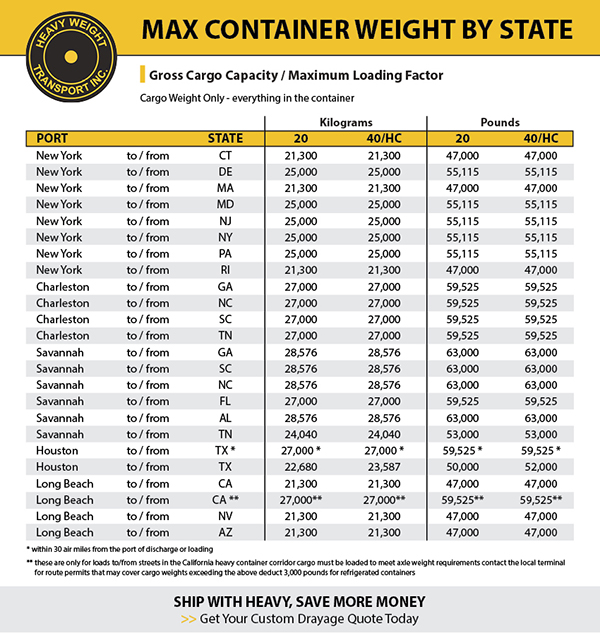
Current state of play: Convert the primary principles of state weight limits into a one-pager that your planners and warehouse leads will use. By referring to a quick table by port/lane and container size, “red-zone” weights can help you contact Heavy Weight more quickly to get a personalized checklist that includes VGM-quality weighing and route check before dispatch.
Stop Guessing Your State Weight Limits
You can control container weight, but it’s not easy to track 50+ state sets of evolving rules. Get the tools, rule of thumb, and a partner who can translate state complexity into clear “yes/no/how” answers per lane.
Contact the Heavy Weight team to secure the state weight limits guidance you need.