

You know late spring through early fall is one long, busy shipping stretch, but this year’s peak season is shaping up to be a lot longer, bumpier, and cost-intensive.
With the reality of tighter capacity, higher surcharges, and less predictable timing — on top of what is being called a “dual chokepoint crisis” from the Iran conflict — you need to get ahead of real-time impacts.
To help plan, Heavy Weight Transport is here with our peak-season playbook with top tips to confidently manage one of the most complex long seasons in recent years.
→ Play 1: Book Heavy and Standard Loads 2–4 Weeks Out
Goal of the play: Lock in drayage and appointments before the peak season crunch.
The Express Carriers Association (ECA) states that early planning and securing capacity in advance deliver clear benefits, including better inventory management, accurate demand forecasting, and timely order fulfillment. Flexport agrees and advises that ocean FCL shipping should be booked three to four weeks in advance of the cargo’s readiness date during peak season. If you book late, be warned that ports and warehouses will be extremely congested, increasing the risk of rolled containers.
To lock in better rates and avoid challenges during peak season, it’s important to turn to a reliable resource for safely trucking and warehousing heavy and stand-weight shipping containers. Since 1983, thousands of customers in various industries across the U.S. have trusted Heavy Weight to haul their freight daily. Book early to capitalize on our experience when the season tightens.
→ Play 2: Max Out Legal Weight per Move
Goal of the play: Use overweight capabilities to reduce total trips, touchpoints, and exposure.
It’s a known fact that U.S. federal rules cap gross vehicle weight at 80,000 pounds on interstate highways without special permits, and commonly limit single axles to 20,000 pounds and tandem axles to 34,000 pounds. To make sure you max out legal weight per move, you need a provider with a truck/chassis setup and load plan that can get as close to those legal limits on each trip.
Heavy Weight’s reliable fleet of multi-axle chassis is specially created to haul sealed ocean container loads weighing up to 64,000 pounds. Benefits include:
- A greater ability to move containers that most others cannot.
- The benefit of fewer trips, fewer appointments, and fewer chances for congestion or delays during the long, busy season without crossing into permit territory.
- Transporting overweight and standard-weight cargo nationwide, with a vast fleet including eco-friendly, 4-axle trucks, 20-foot, 40-foot, and 45-foot tri-axle chassis — all customized for maximum payload.
- We carry all of the standard overweight permits that may be needed. In fact, our specialty is moving heavy cargo loads legally per state maximums.
→ Play 3: Turn Heavy Containers Fast
Goal of the play: Avoid storage/demurrage by using cross‑dock/warehouse capacity and strong customer service to turn containers quickly.
Securing cross-docking or warehousing services that fit your volume, seasonality, and product characteristics is key to securing service and costs during peak season — especially when demand is high, and capacity is binding.
Not only does Heavy Weight offer multiple cross-dock terminals and warehouses, but we also provide a comprehensive suite of solutions, including drayage, transloading, short-term storage, and GPS tracking to streamline your needs.
Our goals are yours by focusing on providing stellar service across all of our teams with constant communication.
“If it’s specific reporting, rates, or visibility with what’s happening with the container or the breakdown of when we can expect containers to be delivered, the constant communication and customer service definitely sets Heavy Weight apart.”
— Randi Grey, Director, Logistics Customer Service, Global Distribution Team, G3 Enterprises
→ Play 4: See Problems Before the Last Free Day
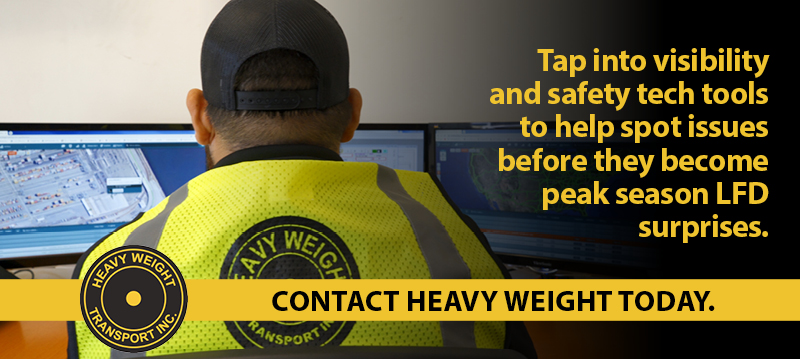
Goal of the play: Tap into visibility tools, including tech and port cameras, to manage risk and appointments during a volatile long season.
The key enabler of resilience in high-throughput periods and gaining an advantage over LFD warnings? Real-time monitoring, sensor networks, and video systems. According to research in ScienceDirect, digital tools help ports optimize flows, reduce congestion, and improve incident response.
Heavy Weight’s chassis and tractor telemetry with GPS location provides the capability for continual visibility of your freight shipment. Our proprietary Transportation Management System (iTMS) for trucking and drayage operations completely automates order receipts and customer service. In addition, our Warehouse Management System links directly to our iTMS for transloading inventory.
→ Play 5: Connect With the Right Escalation Contact & Locations
Goal of the play: Establish trusted, reliable local partners before things get crazy.
“Proactive” is the operative term to thrive in this year’s peak season. And the best way to ensure success is with a partner committed to your long season needs – not a “spot carrier” strategy that compounds risks, including less certain coverage and operational surprises.
Heavy Weight operates around the country with terminals in New York, Charleston, Savannah, Houston, and Los Angeles – the busiest U.S. port for containerized imports. With three warehouses inside the Overweight Container Corridor near the ports of Los Angeles and Long Beach, California – including a bonded facility, allowing shippers to store imported goods for a period of up to five years – Heavy Weight is the only resource within the corridor that handles bundled slabs and slab handling.
In addition to keeping you informed about where your shipment is at any time with our real-time tracking, we provide links to port cameras we serve to watch your shipment and track port activity.
Run Your Busy Season Playbook with Heavy Weight
Share your busy season calendar and target “on-dock-by” dates with us, and we’ll recommend the right ports, weight strategies, and visibility tools for your lanes.
Contact the Heavy Weight team to secure reliability, lead times, and inventory protection for your next heavy or standard-weight move.